Wednesday, 14 May 2014

How has modernism and post-modernism changed our world for the better?


Well before I can answer that question I first have to define what modernism and postmodernism is.  Modernism is defined as “A style or movement in the arts that aims to depart significantly from classical and traditional forms” . In modernism, there are 3 phrases;

Between 16th- 18th century  “called the Early Modern Period” 

The French Revolution between 1789 -1799 “France went from a monarchy ruled by King Louis XVI to a republic ruled by the people …and then to a dictatorship run by Napoleon” 

The 20th century – “The process of modernization expands to take in virtually the world and the developing world culture of modernism achieves spectacular triumphs in art and thought” 
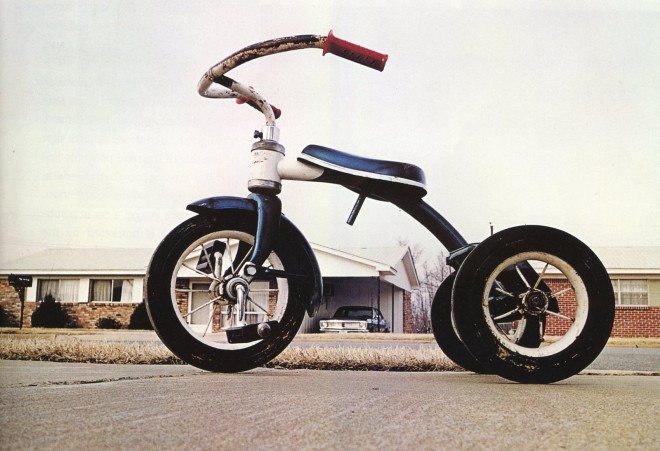
An example of a modernist photographer is William Eggleston. Eggleston’s photo of the child’s bicycle was of that particular time (the 1970s).

Postmodernism is defined as “A late 20th-century style and concept in the arts, architecture, and criticism, which represents a departure from modernism and is characterized by the self-conscious use of earlier styles and conventions, a mixing of different artistic styles and media, and a general distrust of theories” 

I would say that Cindy Sherman is good example of postmodernism photography. Sherman is a self-portrait photographer, and her film still in the early part of her career. This really shows photography in a different way. The film still in black and white and made to look like the old movies of the early 50s/ 60s.

In essence, modernity refers to "historical, cultural political and economic conditions related to the enlightenment (18th century philosophical movement) the rise of industrial society". This was due to " the formation of republics based on explicitly modern political ideals such as liberal democracy" which happened during the French and American revolutions.I think that this had a great impact for generations to come, "in the form of industrialization and technological advancement" to a "communist ethos of equal benefits and living conditions for all citizens".

So to answer the question modernism and postmodernism has done a lot for us, it means that creative people and the public alike can expression themselves through creating art/photography and we as the public can look and comment on it.

Bibliography

Online

Arthistoryresources.net, (2014). Modernism: The Roots of Modernism. [online] Available at: http://arthistoryresources.net/modernism/roots.html - accessed on 14/05/14
 Cliffsnotes.com, (2014). I don't really understand the French Revolution. What started it, and what stopped it?. [online] Available at: http://www.cliffsnotes.com/cliffsnotes/history/i-dont-really-understand-the-french-revolution-what-started-it-and-what-stopped-it - accessed on 14/05/14

Oxforddictionaries.com, (2014). modernism: definition of modernism in Oxford dictionary (British & World English). [online] Available at: http://www.oxforddictionaries.com/definition/english/modernism - accessed on 14/05/14

Oxforddictionaries.com, (2014). postmodernism: definition of postmodernism in Oxford dictionary (British & World English). [online] Available at: http://www.oxforddictionaries.com/definition/english/postmodernism - accessed on 14/05/14

Book


Berman, M. (2001). All that is solid melts into air. 1st ed. London, Verso

Sturken,M and Cartwright,L (2009) Practices of Looking 2nd ed, Oxford, New York, Oxford University Press


Monday, 12 May 2014

BBC 2 “Blur the Lines the New Battle of the Sexes”


Kirsty Wark investigates the inequality between the sexes.  How misogyny and the growth of sexism towards women has become widespread in social media and gaming.  She also looks at how different attitudes mostly from men are counter-balanced with how women feel about it as well as talking to a wide range of people from psychologist to comedians and feminist.
In this one hour special, Kirsty Wark goes on a journey to gain a greater understanding of why there is so much misogyny and sexism in society. In turn this has dramatic consequences, causing in certain situations for women to be abused or threatened to be attacked. 

Kirsty Wark defines what both sexism and misogyny is:
Sexism – Is prejudice and discrimination against men or women.
Misogyny – Is personalised sexualised and often violent towards women.

During the late 80s, imagery of the sexes had changed:
For women = “For women it was power suits” Kirsty Wark
For men = “For men there was the new man from posters to advertising” Kirsty Wark

Throughout that time there was a rise of UK pop with groups like Oasis and Blur. This in turn changed popular culture and there was a magazine that celebrated it. “In 1994, Loaded busted onto the scene with a swagger, a beer can and a topless women.    
Kirsty Wark interviewed Martin Dobney, Loaded longest running editor. In this interview, I learned about who the readership of the magazine (white, working class males). Martin Dobney stated that “Loaded was a reaction to that with 2 fingers up” against the “asexual image of what men had been told to be” by older generations. Kirsty went onto say “we are celebrated women …but it was more about their looks” Then Martin Dobney admitted that women in their magazines were used as objects “sales devices, they did sale magazines because if you put a man on the cover of a man’s magazine, it was commercial suicide”. 

Later on, Kirsty Wark sums up the programme with these final statements “ young women and men deserve to grow up in a society that women and men have mutual respect.” “We are at a moment at where misogynic views are tolerated and gain a solid footing there’ll be destructive consequences for the next generation and that’s not a laughing matter for any of us. Both of these statements I agree with. I would definitely recommend this show for everyone to watch because if you watch this you will learn something.


Bibliography

Blur the Lines the New Battle of the Sexes, 2014, TV special, BBC2, London 

Image

Advertisting photo - http://img.rlsbb.com/images/2014/05/09/624.jpg - accessed on 12/05/14


Sunday, 4 May 2014

The Big Debate – 'THIS HOUSE BELIEVES THAT SOCIAL MEDIA IS MAKING LIFE WORSE'


I took part in this debate for the last lesson of discourse. I decided to be on the side that was for social media. There were 3 people on either side for and against and other people in the class got a chance to give their opinion on the topic of social media as well. 
The debate started off with the side that was against social media. The points that come up were:

Because of social media, kids and teenagers are spending all their time indoors instead of playing outside or meeting in person with friends.

Bullying amongst kids and teenagers has increased due to cyber bullying

On sites like Facebook, if a person uploads an image, Facebook own the rights to that image.

Then, we moved on to the side that was for social media. The points that were highlighter are:

   Social media has helped women bridge that gap between men in the business world leading to women setting up more of their own businesses.

   Social media is good because people are able to communicate with long lost school friends that they haven’t spoken to in years.

Social media is a powerful, immediate communication tool. However it comes with great responsibly and the need to self regulate. Whatever you put in reaches a very wide audience at great speed and you cannot change the consequence.


After that it was the other people’s turn to take part in the debate. Here are the general points.

     Celebrities should be more responsible for the images that they put of themselves on social media because some of them have very young fans that can be influenced by what they see.

A few people were unsure whether social media was a good thing or not.

    Young people on social media use text speak (slang) instead of Standard English to talk to each other.

Social media users should not put anything (written/images) on sites that they would not want everyone to know about.


Even though I support social media, like everything in the world, there are positives and negatives of social media. I believe that social media sites are very good. Social media is the future and if you don’t embrace them you will be left behind.

Bibliography

Discourse lecture, The Big debate, 'THIS HOUSE BELIEVES THAT SOCIAL MEDIA IS MAKING LIFE WORSE', supporting for the debate, 02/05/14

Images
Photo of debate in lecture, 02/05/14, University of East London

Snoopy - http://theundercoverrecruiter.com/how-social-media-will-help-your-job-search/ – accessed on 04/05/14
Social media logos - http://www.cosmic.org.uk/consultancy/social-media  – accessed 04/05/14  


Sunday, 6 April 2014

Cindy Sherman and the Feminist Movement


Cindy Sherman was born on 19th January 1954. Sherman studied photography at State University College in Buffalo. In the early 1980s Sherman’s popularity grew in the New York art scene. She brought out a series of untitled film stills, photo taken from 1977-1980. “Sherman places herself in the roles of B-movie actresses” “dressed up in wigs, hats, dresses clothes unlike her own, playing the roles of characters.” 

This particular photo, I like because of the shallow depth of field having the background really blurry and Sherman herself in focus, makes for an interesting photo.

Most of Cindy Sherman’s photo feature herself in the picture but are not considered to be self-portraits because usually person in the photos look nothing like Sherman at all.  This photo was one of the characters which can be open to interpretation. I think that the photo is brilliant because of the sheer effort that Sherman would go to with the make-up and hair

Many people say that Cindy Sherman was a feminist but Sherman does not claim to be a feminist artist at all. “. This is feminism and Cindy Sherman is their knight in shining tinted moisturizer” 

For me this such a powerful quote because Sherman does not claim to be a feminist artist but her photographs expose the different scenarios that women face all the time. I think that all feminist and women in general can relate to Sherman photography.


Bibliography

Websites

Online interview with Cindy Sherman – accessed on 06/04/14 http://www.theguardian.com/artanddesign/2011/jan/15/cindy-sherman-interview

Cindy Sherman biography - http://www.cindysherman.com/biography.shtml - accessed on 06/04/14

Cindy Sherman article - http://hyperallergic.com/51316/how-to-talk-about-art-cindy-sherman/ - accessed 06/04/14

Images


A women’s-liberation parade on Fifth Avenue, in New York, in August, 1971 -http://www.newyorker.com/arts/critics/books/2009/11/16/091116crbo_books_levy?currentPage=all – accessed on 06/04/14


Untitled film stills - http://resourcemagonline.com/wp-content/uploads/2012/02/cindy2.jpg - accessed on 06/04/14


Saturday, 5 April 2014

The Life and Work of Richard Avedon


On the 15th May 1923, Richard Avedon was born. Throughout, Avedon career he has been known for “his minimalistic portraits” and “demanding that his models convey emotion and movement” 

During 1942 – 1944, Avedon worked as a photographer taking identification portrait for the Merchant Marines. Then left and studied photography at the New School for Social Research in New York City. Avedon worked with Alexey Brodovitch, “the acclaimed art director of Harper's Bazaar” 

Both became good friends and then after a while Alexey Brodovitch offered Avedon a job at Harper’s Bazaar. Avedon work at Harper’s Bazaar from 1945 – 1965. One of his most famous photo shoots was of Dorothy Horan, best known as Dovima, with elephants. This photo for is very elegantly composed and is quite magnificent to look at.

Out of the portraits that Avedon has taken the photo of John F Kennedy and his wife Jackie is my favourite because if you think about this photo has captured social history. The photo of them is the only physical memory of them left, because they are sadly not with us.

I came across this quote from a book “Richard Avedon was fifty-five years old in October of 1978 and at the top of his game.” (Wilson, L, 2003, Avedon at work, In the American West) The book shows how Avedon turns to this new project of photographing the American West. One of the places Avedon went to was Lyons, Texas, where he took a photo of Roberto Lopez. This was on 28/09/1980, during the big energy boom of that time. Roberto Lopez had been working “for forty-eight hour straight” and when asked to be photographed “he was shy and hesitant” (book). I like the simplicity of this photo. I can see that Roberto Lopez a worker and sense of tiredness in his eyes. Also, I think the composition of Lopez in the frame to one side makes for an interesting photo.

Richard Avedon passed away on 1st October 2004, aged 81. In retrospect, I feel that Avedon has achieve a lot in his life and will be remember as one of the great photographer of the 20th century.

Bibliography 

Websites

Images
Dorothy Horan, best known as Dovima, with elephants (1955) http://rebeccaprowler.files.wordpress.com/2008/09/avedon-elephant-picture.png - accessed on 04/04/14

Books
Wilson, L, 2003, Avedon at work, In the American West


Sunday, 30 March 2014

What makes Annie Leibovitz photos so iconic?


To first answer that question, you need to know a bit about Annie Leibovitz to start with.  Annie Leibovitz was born on 2nd October 1949. Leibovitz worked at Rolling Stones magazine in the 1970s, then moving on to Vanity Fair in 1983. Known for taking portraits of famous musician, political figure and athletics. Leibovitz went as tour photographer with the Rolling Stones band. Leibovitz is mostly based in America, her work is featured in advertising campaigns and magazines as well.

One of her famous Rolling Stone covers was of Meryl Streep. When I first saw this image, it makes me wonder how Meryl Streep pulled so much skin from her face. As a viewer this is the attraction of this photo. In this photo Meryl Streep face is painted white to match the white shirt she is wearing. This for me made the photo more theatrical.

Then, Leibovitz takes a photo of a nude pregnant Demi Moore for the front cover of Vanity Fair. This photo, I would say is very iconic because it was so unique for its time and had never been done before.  The photo for me is one of Annie Leibovitz best because she not afraid to think out the box with her ideas.

One of Leibovitz most daring shoot was Whoopi Goldberg in a bath full of milk. This photograph is my favourite because as a viewer we don’t see all Whoopi Goldberg, just her face, arms and legs. What I like most is Whoopi Goldberg’s skin colour against the milk in the bath that makes for such a high contrast.

Annie Leibovitz still takes such iconic photos today, her recent photo was of Kim Kardashian and Kanye West before they get married in the summer on the American Vogue cover. This is such a beautiful shot of the couple and I really like the dress that Kim is wear as well.

For me, what makes Annie Leibovitz so iconic is that she never scared to take a risk to create brilliant photographic imagery. Leibovitz will go down in history as a great photographer who takes excellent photos.

Bibliography

Websites

Annie Liebovitz biography - http://jb5746a.wordpress.com/2011/10/03/annie-leibovitz-2/ - accessed on 30/03/14

Images
Meryl Streep - http://jb5746a.wordpress.com/2011/10/03/annie-leibovitz-2/ - accessed on 30/03/14


Wednesday, 26 March 2014

What is the relationship between semiotics and advertising campaigns?


Semiotics is about sign and symbols and the interpretation of them.  I have always wondered about the relationship between semiotics and advertising campaigns, because if you think about the two things, they are very similar. Both trying to convey a message, to sell us something or communicate something, for example: Traffic lights (to help us cross safely) and dangerous street signs (to avoid us getting hurt).

While researching more about semiotics, there was one quote that stood out for me; “Every time we interpret an image around us (to understand what signifies) whether consciously or not, we are using the tools of semiotics to understand its signification, or meaning.” (Marita Sturken/ Lisa Cartwright (2009). Practices of Looking, An Introduction to Visual Culture, p27). I totally agree with this statement because we are always trying to understand the world around us. Through the symbols and signs around us, and there are certain symbols that we recognise like the big M for McDonalds which we associate with fast food.   

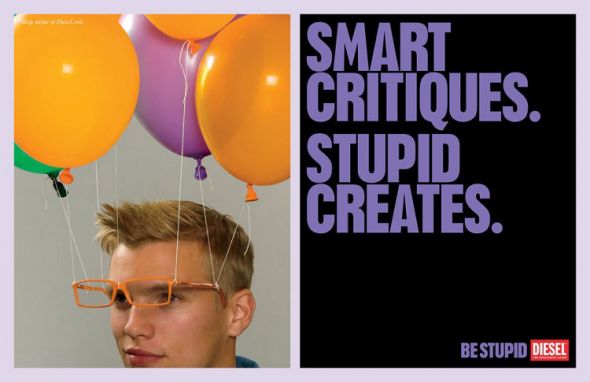
These two adverts Diesel’s Be Stupid and Elige Vivir Sano are very different in their approaches to the layout, image and text. For the Diesel’s Be Stupid campaign, there is a man wearing orange glasses, attached to them are different colour balloons with the words “Smart Critiques. Stupid Creates.” The choice of words speaks to Diesel’s target market (20 – 40 year olds). I really think this advert is quite dynamic because Diesel’s whole ethos is having fun and enjoy yourself.

In comparison, the Elige Vivir Sano campaign was of a strong banana crushing the box of fries with the quote “Exercise your will power”. This I think was an excellent play on words and the illustration demonstrates that beautifully. When I first saw this advert I thought it was very aggressively laid out.I learnt that the relationship between adverting campaigns and semiotics are that they are both similar and are interlinked with other.

Bibliography 

Books
Marita Sturken/ Lisa Cartwright (2009), Practices of Looking,An Introduction to Visual Culture, 2nd edition, USA,Oxford university press, p27

Websites - Images
Diesel’s Be Stupid campaign - http://www.shockblast.net/diesels-best-ad-campaigns/     - accessed 23/03/14
Elige Vivir Sano campaign - http://www.trendhunter.com/trends/elige-vivir-sano-campaign  - accessed 23/03/14